Medium and large-sized residential communities

Medium and large-sized residential communities typically feature large areas, numerous buildings, frequent personnel movement, and complex public areas. Their daily management involves multiple aspects such as security patrols, vehicle order, maintenance of public Spaces, night shifts, and handling of abnormal events. The traditional approach that relies on manual patrols and decentralized management often has problems such as discontinuous coverage, slow response speed, high pressure at night, and high management costs.

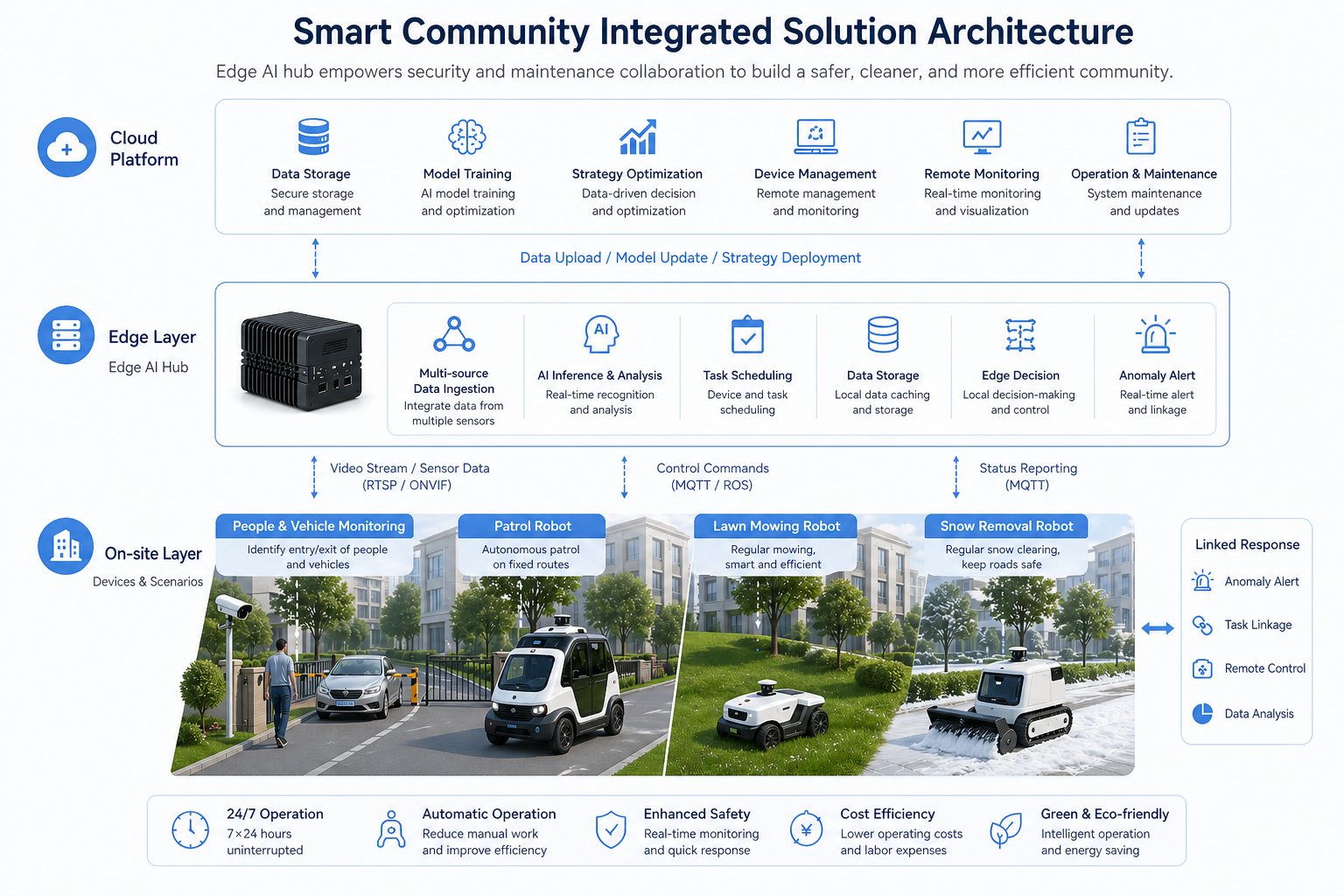
The edge AI central command system for smart communities, designed to meet the actual operational needs of medium and large residential communities, builds a three-layer collaborative architecture of “community on-site layer – edge AI central layer – cloud large model layer”. The system deplores an edge AI hub locally in the community, uniformly connecting cameras, patrol robots, drones, environmental sensors and other intelligent terminals, to achieve continuous perception, local analysis, intelligent decision-making and device linkage of the community site.

It not only helps property management “see problems”, but also enables them to “automatically identify problems, quickly judge problems, collaboratively handle problems, and continuously optimize management”.


Our Solution

In view of the characteristics of medium and large-sized residential communities, such as “high security pressure, long management chains, and numerous maintenance tasks”, the system deploys key capabilities to the local edge AI hub of the community to achieve:

  • Local data processing and real-time identification
  • Unified access and unified scheduling for multiple terminals
  • Local autonomous handling of regular events
  • Cloud-enhanced analysis of complex events
  • Full-process traceability of tasks and operational visualization

Through this “edge autonomy first, cloud intelligence enhanced” architecture, the system can ensure real-time response while effectively reducing its reliance on networks, manual labor, and on-duty intensity, thereby enhancing the stability and intelligence level of the community’s daily operations.


Realized Functions

Perimeter patrol and abnormal intrusion identification

Continuous monitoring and intelligent inspection should be carried out on key areas such as fences, entrances and exits, green boundaries, and underground entrances and exits to promptly detect risk situations such as abnormal entry and abnormal stay.

Nighttime security patrolection

At night or during periods of low foot traffic, patrol robots or other intelligent terminals are dispatched to conduct regular, fixed-point or dynamic inspections to enhance the density of security coverage and the timeliness of response.

Identification of suspicious individuals and abnormal behaviors

By integrating cameras with local AI analysis capabilities, abnormal loitering, abnormal gathering, and prolonged stay in key areas can be identified and warned of.

Inspection of fire lanes and public areas

Automatically detect problems such as occupied fire escape routes, accumulation of debris, and obstruction by obstacles, assist property management in timely rectification, and reduce safety hazards.

Vehicle order and area anomaly detection

Assist in identifying situations such as illegal parking, abnormal road occupation, and vehicle congestion in key areas to enhance the community’s ability to manage order.

Environmental maintenance collaboration

By integrating robots, lawn mowers and other equipment, tasks such as lawn trimming, road inspection and public space maintenance are uniformly scheduled to reduce the burden of high-frequency and repetitive manual labor.

Environmental monitoring and abnormal early warning

Connect sensors for temperature, humidity, smoke, water immersion, etc., to continuously monitor the environmental conditions and achieve early warning of potential risks.

Closed-loop handling of abnormal events

From event discovery, task generation, equipment linkage, on-site handling to result feedback, the system can form a complete closed loop and automatically retain process records.


💡 Key Benefits

  • Local autonomy ensures no network outage even when the network is disconnected.
  • Respond quickly and shorten the disposal chain.
  • Multi-device linkage forms a true closed loop.
  • Reduce reliance on manual labor and optimize operating costs.
  • Strengthen privacy protection and data security.
  • Management is more standardized and the process is traceable

Enable medium and large residential communities to have truly executable intelligent hubs

Scroll to Top